Saturday, 3 August 2013

The Aussie critter list

So our Australia trip has come to an end, with hundreds of memories and (literally) thousands of photos. We have met some amazing animals and been to some incredible places so I thought I would put together a list of all of the creatures we met across New South Wales, Victoria, South Australia, Queensland and Tasmania. 

Australia is a truly unique country, a really lucky land. It is amazing that with very little knowledge we were able to find so much there in just a few months. It also makes you worry that without careful planning, the amazing diversity and quantity of animal life there will not survive continued pressure from humans. The saddest thing would be if Australia become like much of the developed world - deviod of wilderness and lacking large species of animal. Thankfully there are many Aussies that love their wild places and want them protected.

All of the photos here (except 2) are of wild animals that we met on bushwalks, on beaches, in parks and even by the side of the road. They are split up into some very broad taxonomic groups, and I have done my best to identify species where possible.

Mammals

Brushtailed possum
Ringtailed possum
Bart the wombat (not a wild wombat!) a southern hairynose wombat
A wild common wombat in Tassie
Wombats have square poo!
An echidna in the Dandenong hills, Victoria
Eventually found a wild platypus in Tassie
He swam around for about half an hour around dusk
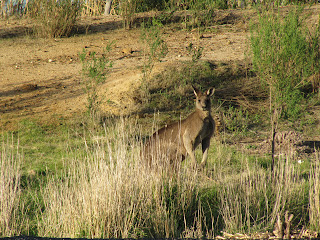
Eastern grey kangaroo just out of Melbourne
A whole gang of roos!
Grey headed flying foxes in Victoria
They fly to find food at sunset, just as the outdoor cinema starts

There are loads of wallaby species, this is probably a Tasmanian Bennett's wallaby
Also in Tasmania, so probably a Bennett's
Victorian wallaby, so likely a swamp wallaby

"Are there likely to be koalas round here? Oh. There's one!"
This is also not a wild tassie devil. He's called Oscar. The Devils@Cradle sanctuary are part of the tasmanian devil conservation project, looking to protect devils against devil face tumor disease.

Birds


Crested pigeon
There are sulphur crested cockatoos all over Australia. I think they're ace.
Believe it or not, actually a wild pair of king parrots at Lake Eildon, Victoria
Australian magpie, aka the Ooglie Booglie Bird (it has a really distinctive call)
Australian pied cormorant
Black swan, not the Darren Aronofsky type
Corella
Currawong
Kookaburra sits in the old gum tree...
Some sort of egret
Little penguin. Awwww... So cute!
Masked lapwing
Nankeen kestrel
Rosella
"Oh my god it's an ibis! Oh. They're as common as pigeons..."
Galah. The best bird in Australia and possibly the world.
You can see them in Bristol Zoo, or in just about any park in Australia
Night heron
A superb lyrebird, mid-display
Wild budgie!!
No idea what this is...

Silver gulls, smaller than a herring gull but just as lairy


Reptiles


Blue Mountain water skink - an endangered species
Tasmanian skink, not sure of the species

A house gecko in Queensland
Australian Water dragon
They're a common sight in Sydney
There are lots of species of freshwater turtles, these ones were in Queensland

Invertebrates

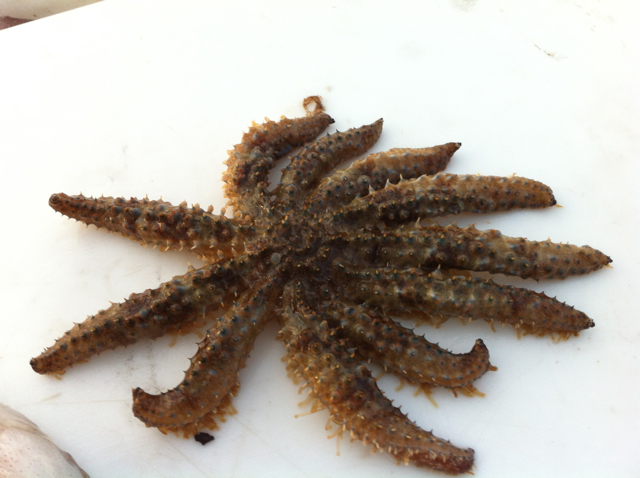
An 11 armed sea star - count the arms!
Bull ants are not to be messed with!
Jack jumper ants, a type of bull ant. These are fiesty critters and will wave their jaws at you in a menacing way.
A false garden mantis, Pseudomantis albofimbrata
An emporer gum moth caterpillar
They're big!!
No idea what this thing is! Answers on a postcard...
Orge-faced spider
The famous huntsman spider
This redback lived right outside our front door

Fungi

And finally...

You do have to be careful in some parts of Australia
If the crocs and sharks don't get you, then the jellyfish might!

And there are reminders of the real danger of the bush most places you go - not the animals, but the plants. Most species of eucalyptus are resistant to fire and some even need it to spread their seeds. Some gum trees shed bark which covers the forest in kindling and there is very little summer rain in many states. Bush fires are a real danger in the summer months, and not always restricted to rural locations. Bush fires can move faster than a car and destroy everthing in their path, but they are very much a natural part of Australia and a reminder that Westerners are only a very recent introduction to Australia. 

Of course humans have been living in Australia in a sustainable way for thousands of years. By imposing our lifestlye on Australia, Europeans have mostly brought disease, turmoil and change for indigenous Australians. That is not to say that we should all live as people have lived in Australia for ten thousand years, but properly understanding the connection and respect that the indigenous peoples have with their land is something that would benefit the wildlife and the country as a whole.

Sunday, 3 March 2013

Aussie critters

Many people think of Australia as a land infested with some of the most deadly and ferocious critters that the world has ever seen. Particularly in the UK, many people imagine that every garden, park and dunny has lethal monster waiting to kill poor unsuspecting tourists.

Of course, the reality is nothing like this. 

One of the biggest mistakes that Brits like myself are likely to make before coming down under is to underestimate just how big Australia is. The country has a land area of 7.69 million square kilometres, not far off the 9.83 million square kilometres that is the land area of the USA. In comparison the UK is a piddling 0.24 million square kilometres. A quick bit of maths tells you that the UK will fit into Australia more than 30 times. 

So Australia is a BIG place. And so although there are some dangerous animals, they don't all live in the same place. You're not gonna get eaten by a salty, and bitten by a tiger snake and a redback all in the same day. 

Here are some of Australia's usual suspects:

CROCODILES

Saltwater crocodile (human for scale!)
So this is me and a saltwater crocodile, and no, it's not a wild one. You only get salties up in Northern Queensland and the Northern Territory. They are big and they are mean, and they do sometimes eat people. Really big salties (5m+) are rare these days, but this one was at least 4m long, and despite their size, it is actually Nile crocodiles that are more of a danger to humans because they are far more likely to come into contact with them. Nevertheless, I can't think  of a better reason not to go swimming in the water in northern Australia. 

JELLYFISH

Box jellyfish, or to be precise, Chironex fleckeri, are not too nice either. There are actually a whole shedload of jellyfish that come under the term 'box jellyfish'. They have a bit more of a nervous system than most other jellyfish, they have eyes not dissimilar to humans (except they have 24 of them), and it is thought can even show simple learning. C. fleckeri do have an extremely painful sting, that can kill in a matter of minutes, but there are relatively few documented cases of deaths in Australia - 64 since 1883. Being oceanic, they're not restricted to Australia, you're also likely to bump into one of these guys in much of South East Asia, including Thailand, Vietnam, Singapore and Indonesia.  

SNAKES


Here's a picture I took of an inland taipan in The Australian Museum. This is the most venomous snake in the world (although this particular one isn't because it's dead). We've also seen live ones in zoos, but despite enthusiastic (although careful) looking we are yet to see a live wild snake in Australia. We've seen a ton of lizards, and even a green turtle, but not one snake. If we were to see one, it would most likely be a brown snake, which do have a nasty bite if disturbed, it would definitely not be one of these because we would have to be in the middle of the bloody desert! Hence the 'inland' bit of their name - they don't live where most of the people do. 

SHARKS


This is a picture of a grey nurse shark, a species native to Australia, this particular one lives in Sydney Aquarium. There are sharks in the water in many places in Australia. There are often shark nets on beaches to protect bathers so you do need to be careful. Having said that, on one trip to Manly in Sydney there was a 'Warning! A shark has been spotted in the water!' message playing on repeat that all of the surfers and bathers were completely ignoring. Again, it depends where you are - some bits of Western Australia are considered particularly dangerous and there were 14 attacks and 2 fatalities in  Australia last year. What is clear from those sorts of stats is that although sharks can be dangerous, if we are sensible with where and when we use the water, there is very little chance of being attacked. Species like the grey nurse are also, like many shark species, endangered, with millions of sharks killed each year, often 'finned' for shark fin soup. Sharks certainly have more to fear from us than the other way round. 

SPIDERS

So on to my favourites, the spiders. There are lots of cool spiders to be found in Australia, here are a few:

St Andrew's cross spider in Centennial Park, Sydney
Orge-faced spider, with a net of silk
Huntsman spider - big, fast and harmless
All of these spiders are entirely harmless, although some, like the huntsman, are fast enough to really freak you out if you're not expecting them. We've also been looking for spiders for the best part of four months now and these are the weirdest that we have found. No red-backs, no Sydney funnel webs, not even a golden orb web (although we did get to see a live one at the Melbourne Museum). 

So Aussie spiders, like most other feared Aussie animals are there if you go looking for them, but you have to look quite hard. We have been really lucky however, because we have got to meet a huge number of unusual wild Australian animals: kangaroos, koalas, echidnas, wallabies, possums, galahs, king parrots, rosellas, lorikeets, green turtles, ibises, cockatoos and even a budgerigar. 

I'll be putting up a whole photo diary of our full animal encounters when we come to the end of our time in Australia. Hopefully by then it might include one or two of those more dangerous critters that Australia is so famous for. And I'm sure I will survive to tell the tale. 

The bug-iest wedding that there ever was


My now wife and I made good on our plan to bring our love of all things creepy and crawly to our wedding, back in September of last year. Thanks to the efforts of Martin French of Bugz UK who rented the bugs to us (I think Martin was unaware that he rented bugs before the wedding...), and trusted us not to kill them. Thanks also to the beautiful craft skills of the brilliant Bea Roberts (who is also a rather brilliant writer) who made us some brilliant bug bunting that you see above.

 Anyway, I thought it would be nice to document the critters that inhabited the tables of our special day. Our guests were presented with a scene like you see below on each of their tables:


They eventually noticed that the little figure in the centre of the table was not only correctly labelled with its italicised binomial name, but also very much alive.

Here are some of the highlights:


A fantastic Hierodula unimaculata
Heteropteryx dilatata, better known as the jungle nymph the heaviest stick insect
Extatosoma tiaratum, the Macleay's Spectre. Complete with poo.
Deroplatys dessicata, the Malaysian dead leaf mantis
Sphodromantis aurea, the Congo green mantis
Aularches milliaris, colourful grasshoppers from Pakistan
Despite their unusual dining companions, the guests seemed to enjoy their living table decorations, and all of the critters survived their wedding experience and were returned to Martin safe and sound. We had a fantastic wedding day, and I think having that extra bug touch during the reception really made it feel like 'our day'.

Thanks again to the very talented Matt Kay for the photography, you can see more of his work at fotokay.net.

Monday, 10 September 2012

Arachnophobia - LIVE!

Having been on stage (literally) covered in spiders recently, I thought I would be a good time to record my antics. I started off on the 31st of May, 2012, at Bristol Bright Club #3 - the Nature of Things, Bristol Bright Club being a comedy night where researchers take to the stage and make science funny. Or at least, they make their job funny. I decided to do this by walking on stage with a spider on my crotch.

Which is clearly the correct way to go about making spiders funny. This gig was only the warm up of things to come, and I spent most of the time talking about funny things that children say, or inappropriate things that we accidentally say to them. "You can have a lot of fun with Uranus" (in the context of a planetarium show) was a particular highlight.

Next up was Science Showoff, on the 12th of July. This was much more spidery show and involved getting the show organiser and known arachnophobe, Suze Kundu, up on stage to hold a tarantula in front of around 100 people. What could go wrong? Actually, nothing as both Talulah (spider) and Suze (human) performed admirably. 

Finally, a few weekends past, I took to the stage for a full half hour at Green Man Festival in Crickhowell, Wales. This time Talulah had grown wise to my going-on-stage-with-her-on-my-body-antics and promptly ran onto my back.

And stayed there for the rest of the show. Luckily everyone found that hilarious and so I set about at the task at hand and talked about how spiders really are lovely and fascinating animals, and you should only be scard of ones that have nasty bites or are unfriendly. Ones like Xena, the goliath bird eating tarantula.

Who although not dangerous, has something of an attitude issue. She's also very fast, and getting faster with each and every moult. Up to 9 inches legspan so far...

But despite the horrible weather and the potentially terrifying animals, I still managed to draw a very respectable crowd, which probably numbered around 250 people by the end of my half hour. Everyone was full of further questions at the end, and although some hardened arachnophopics were decidedly unmoved by my plea to love rather than fear our eight-legged friends, I think Xena in particular has gained some new admirers. Talulah also eventually made her way onto my front so was recovered safely and they are all now resting at home in the bug house.

Thursday, 24 May 2012

Nicey nicey zoo zoo

So just a little post to say that some of the bugs and me are off to work at Bristol Zoo for a bit!
I'm now an Education Officer in the Zoo Education Centre and so get to talk to kids all day about how awesome animals (and especially bugs) are. Luckily some of the bugs from the bug house are coming with me. The zoo wanted to beef up their stock of Madagascar Hissing Cockroaches so I've donated a load of my ones to the Education Centre too. Should be lots of fun for everyone! Let's all sing: